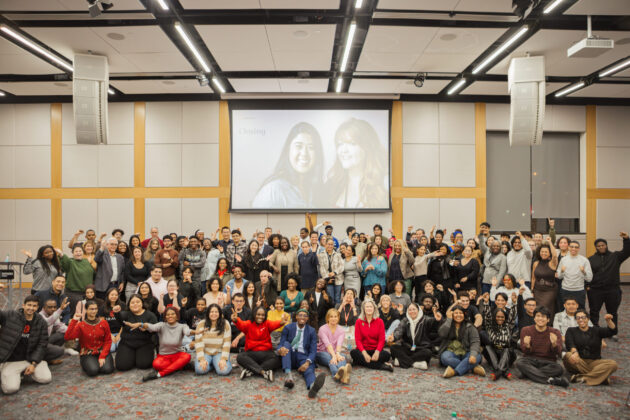
As we close out 2025, I am filled with deep gratitude for the partners who continue to push New Jersey toward a more equitable future, for the community leaders who carry so much on their shoulders, and for the opportunity to join the Geraldine R. Dodge Foundation and the incredible team this year as its President & CEO.
This has been a year of listening, grounding, learning, and charting a clear path forward. And it has also been a year of real progress and movement toward the kind of New Jersey where every family has the chance to build stability, build opportunity, and build wealth across generations.
A Clear Strategy to Close the Racial Wealth Gap
Over the past several months, we have refined and affirmed our strategic focus: to close New Jersey’s widening racial wealth gap through two central pillars—expanding housing choice and increasing economic mobility and security.
This direction builds on years of research and partnership across the state, including the staggering data from the New Jersey Institute for Social Justice on the nearly $640,000 wealth gap between white and Black/Latino households in New Jersey. This gap is not an accident—it is the result of decades of policies and programs that disenfranchise Black and Brown communities. However, that means it is also something that we can collectively work to combat. Our work now centers on supporting organizations that are advancing solutions in increasing access to safe and affordable housing, providing programs that build income security and mobility, and solutions that create new pathways to more equitable wealth-building.
Additionally, over past few months, we were able to welcome multiple, new organizations to our portfolio of partners – organizations who are working across our state on housing choice and economic mobility. Their stories illustrate the kind of community-driven, practical solutions that create real impact:
Eva’s Village: Stabilizing Families and Creating Mobility Pathways in Paterson
For more than four decades, Eva’s Village has been one of Paterson’s most trusted anchors and a comprehensive social service provider offering more than 20 integrated programs. They reach deep into the heart of our target communities, supporting residents facing acute housing instability, food insecurity, unemployment, substance use challenges, and the compounding effects of poverty.
We are supporting their work over the next year to achieve significant impact:
- At least 200 clients will be supported by emergency and transitional housing paired with case management services that provide stability and dignity.
- More than 350 residents will be supported in job training, financial literacy courses, and credit-building workshops.
- Their integrated model connects housing with employment, recovery support, and family services.
Eva’s Village provides wrap-around services to residents across Paterson including people like Stan, a Paterson resident who came to Eva’s Village after years of housing instability and substance use had disrupted nearly every part of his life. When Stan arrived at Eva’s Village, he found more than immediate support. He found a clear pathway toward stability. He began his journey at Eva’s Halfway House for Men, where integrated services helped him focus on sobriety, strengthen his mental health, and begin rebuilding a sense of direction. What stood out most to him was the culture of care. As Stan shared, “For anyone that really wants to get their life together, Eva’s is the place to come. Everything you need is here, and they helped me get my life back on track.”
As he prepared to take the next step, Stan transitioned to Eva’s Men’s Shelter, where staff worked closely with him to navigate the process of securing permanent housing. After five months, Stan moved into his own apartment, living independently, paying his bills, preparing his own meals, and returning each day to a place he can call home. He now regularly returns to Eva’s Men’s Shelter to mentor other residents, proud to serve, in his words, as “an example, not a sample.”
Eva’s Village demonstrates what happens when organizations ensure residents don’t just stabilize, but have a path forward.
Trenton Health Team: Harnessing Data to Drive Systems-Level Change
In Trenton, Trenton Health Team (THT) is redefining what it means to align health, housing, and economic stability. Trusted by residents and respected by policymakers, THT is uniquely positioned as the region’s data backbone—one with access to state administrative data systems that reveal how families interact with public benefits and services.
This includes data from programs like SNAP, Medicaid, and Unemployment Insurance, which are essential for understanding residents’ lived realities and the systemic barriers they face.
THT’s contributions to our strategy are invaluable:
- They are helping us build robust baseline data sets that will allow the Foundation to track the short- and long-term impact of our investments across our target communities.
- Their rapid-cycle evaluation approach allows us to test ideas, assess real-time outcomes, and refine strategies more quickly.
- They provide deep insight into how policy, benefits access, housing, and health intersect—ensuring we focus our investments where the potential for impact is greatest.
In a state where data is often siloed or outdated, THT offers something rare: a clear, trusted window into the experiences of the communities we aim to serve.
As Gregory Paulson, CEO of Trenton Health Team, said: “This grant strengthens our ability to combine community experience with rigorous data analysis to help build effective, equitable solutions. We are proud to be collaborating with the Foundation to tackle New Jersey’s racial wealth gap.”
Braven: Launching First-Generation Graduates Into High-Mobility Careers
At Rutgers–Newark, Braven is transforming what economic mobility looks like for first-generation and low-income college students. Their model is rooted in a simple but powerful truth: career readiness and degree completion are among the strongest predictors of lifetime earnings and wealth-building.
And Braven’s results are remarkable.
- Rutgers–Newark’s graduation rate for first-time, full-time students in 2023–24 was 65%, compared to 91% for Braven Fellows.
- Braven Newark Fellows achieve 26 percentage points higher job attainment within six months of graduation than their national peers.
- In 2026, Braven will expand its Accelerator Course to at least 950 Rutgers students, helping ensure they secure strong first jobs or graduate school placement within six months of graduation.
This work matters because a strong first job is often a lifetime turning point.
Take Asare Bampoe-Parry, an undergraduate student at Rutgers University-Newark (RU-N) who went through the Braven Accelerator in Spring 2025. When he started at Rutgers, he wasn’t certain where his academic journey would lead, and he didn’t yet envision a clear career path or see graduate school in his future. However, after participating in the Braven Accelerator, his outlook had shifted dramatically. After graduating in May 2025, he moved forward with both a strong first job and plans to begin graduate school in the fall.
“I give credit to the opportunities offered at Rutgers and Braven for, honestly, being a catalyst in terms of how I turned my life around academically,” Bampoe-Parry shared.
Braven is proof that with targeted support, the path to wealth-building can widen for thousands of New Jersey students.
Advancing Innovative Solutions for Shared Prosperity
In addition to deepening our grantmaking partnerships, 2025 was a year of testing and advancing new models that can shift systems and accelerate progress toward closing the racial wealth gap. We focused on approaches that leverage the full range of the Foundation’s tools, including grantmaking, impact investing, and convening, to help New Jersey emerge as a place where innovative, equity-centered solutions can take root and scale.
One example is our support for Rutgers’ Institute for the Study of Employee Ownership, a nationally recognized leader in researching and advancing worker- and profit-sharing models. This partnership centers on building the evidence base for employee ownership as a pathway to economic mobility—one that can increase wages, strengthen job stability, and allow workers to build assets over time. By grounding this work in rigorous data and real-world implementation, we aim to help position New Jersey as an early leader in employee ownership strategies that can inform national practice.
We also made a strategic investment in Esusu, a fintech platform reshaping how renters build credit, alongside Westbound Equity Partners, Blue Meridian Partners, and others. Esusu’s model directly advances both pillars of our strategy, housing stability and economic mobility, by addressing a long-standing inequity in the credit system. While mortgage payments routinely help homeowners build credit, renters have historically been excluded, leaving many “credit invisible” and facing higher costs for housing, loans, insurance, and other essentials.
By enabling on-time rent payments to be reported to credit bureaus, Esusu helps renters build strong credit histories and opens doors to lower costs and greater financial opportunity. Already, 2,000 New Jersey residents have established a credit score with Esusu, and we are partnering with them to grow their outreach in our state.
As we work toward a New Jersey where all families can build stability and wealth, we are proud to support innovators who are changing the systems that determine who has access to opportunity, and who does not.
A Look Ahead
Looking toward 2026, our priorities remain clear:
- Deepen our investments in housing choice, economic mobility, and community-rooted innovation.
- Expand our outreach, ensuring organizations across New Jersey know that the Dodge Foundation is here to partner and ensuring organizations outside of New Jersey know that our state is ready to pilot, grow, and scale new ideas.
- Strengthen cross-sector collaboration, including with leaders in government, business, and philanthropy, to accelerate the scale of solutions.
- Continue listening to communities working on the front lines of inequity.
We look forward to working in partnership and collaboration with everyone across the state working to close the racial wealth gap, including our incoming Governor-elect Mikie Sherrill. In November, I was invited to join an Interdisciplinary Advisory Task Force that will bring together voices from across New Jersey — representing labor, business, veterans, the environment, healthcare, education, and more. As we tackle these big issues, I will carry forward the lessons and perspectives of our communities to reinforce the message that addressing affordability requires addressing inequity, and addressing inequity requires partnership. None of this work is possible alone.
To every grantee, partner, leader, and community member who shared insights, stories, and candid reflections with us this year: thank you. Your work shapes our understanding of what is possible.

Samra Haider
Samra Haider is President and Chief Executive Officer of the Geraldine R. Dodge Foundation, where she leads the organization’s mission to close New Jersey’s racial…